



- This event has passed.
“The American Upper Paleolithic and Evidence from the Gault Archaeological Site” Online Presentation
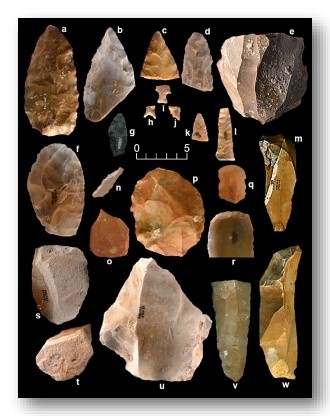
Be sure to join Old Pueblo Archaeology Center’s “Third Thursday Food for Thought” program on Thursday, June 18, 2026, featuring “The American Upper Paleolithic and Evidence from the Gault Archaeological Site” by archaeologist D. Clark Wernecke, Ph.D. This free online Zoom presentation will be held from 7:00-8:30 pm ARIZONA/Mountain Standard Time (same as Pacific Daylight Time).
Since the 1970s the archaeology of the earliest peoples in the Americas has gone through a major paradigm shift. The idea that the Clovis technological culture was representative of the first peoples in the Western Hemisphere has been refuted by numerous sites containing culturally dissimilar stone tools and with dates much older. Early estimations of those first migrations of 3,000 years ago were replaced by 10,000 and then 13,700 years ago and now are being pushed back even further to perhaps 30,000 to 35,000 years ago. A number of factors suggest multiple migrations over time and the very real possibility of people arriving in the New World in boats along the coasts. The Gault site in central Texas is one of those archaeological discoveries with dates as old as 20,000 years ago that are beginning to help us understand the ancient past and build new hypotheses regarding the first modern humans in the Americas. Dr. D. Clark Wernecke recently retired as Director of the Prehistory Research Project at The University of Texas at Austin and as Executive Director for the Gault School of Archaeological Research. He is a director of the Texas Historical Foundation and on the editorial boards of several history and archaeology magazines and journals.
To register for the Zoom webinar go to https://us06web.zoom.us/webinar/register/WN_HszxiMafRlaEt96O8xD3Gg. For more information contact Old Pueblo at info@oldpueblo.org or 520-798-1201.
Flyer: 20260618(v1)ThirdThursday_ClarkWernecke_TheAmericanUpperPaleolithic
Caption: 16,000-20,000-year-old tools from the Gault site, photo courtesy of Clark Wernecke