



Old Pueblo Archaeology Center
Presentations by Archaeologist Allen Dart
Mr. Allen Dart, a Registered Professional Archaeologist, is the executive director of Tucson’s nonprofit Old Pueblo Archaeology Center, which provides educational and scientific programs in archaeology, history, and cultures. Al has worked and volunteered as a professional archaeologist in New Mexico and Arizona since 1975 for state and federal governments, private companies, and non-profit organizations. He served as President of the Arizona Archaeological and Historical Society (AAHS) in 1991-1993 and founded Old Pueblo Archaeology Center in 1993 to provide educational and scientific programs. A mem-ber of several archaeology advocacy organizations, he has received the Arizona Governor’s Archaeology Advisory Commission Award in Public Archaeology (1997), the Arizona Archaeological Society’s Professional Archaeologist of the Year Award (2012), the AAHS Victor R. Stoner Award (2016), the American Rock Art Research Association’s Education Award (2023), the Outstanding Supporter Award from Arizona Humanities, and other honors from AAHS, the Arizona State Historic Preservation Office, the Arizona Archaeological Council, the National Park Service, the US Natural Resources Conservation Service, and other organizations for his research and his efforts to bring archaeology and history to the public.
The term “precontact” below refers to the time before non-Indian people from outside the Americas entered the US Southwest. (The earliest contact was in 1539 in Arizona and New Mexico.)
Except where specified otherwise, hosting organizations should allow at least 1½ hours per presentation.
Presentations Listed Alphabetically
Ancient Native American Pottery of Southern Arizona: Mr. Dart shows digital images of Native American ceramic styles that characterized precontact and postcontact eras in Arizona, and discusses how archaeologists use pottery for dating archaeological sites and interpreting ancient lifeways. He discusses the importance of context in archaeology, how things that people make change in style over time, and how different styles are useful for identifying different cultures and for dating pottery. He also shows illustrations of the pottery styles that were made in southern Arizona by the ancient Early Ceramic and Hohokam cultures, and historically by Piman (Tohono O’odham and Akimel O’odham), Yuman (including Mohave and Maricopa), and Apachean peoples from as early as 800 BCE into the early twentieth century.
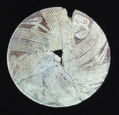 Ancient Southwestern Native American Pottery: In this presentation Mr. Dart shows and discusses Native American ceramic styles that characterized specific eras in the US Southwest prior to about 1450, and talks about how archaeologists use pottery for dating archaeological sites and interpreting ancient lifeways. He explains the importance of context in archaeology, how the things people make change in style over time, and how diverse styles of pottery are useful for identifying different cultures and for dating archaeological sites. His many illustrations include examples of ancient pottery types that were made throughout the American Southwest from about 2,000 to 500 years ago.
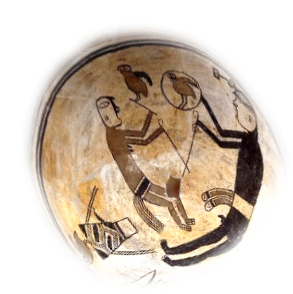
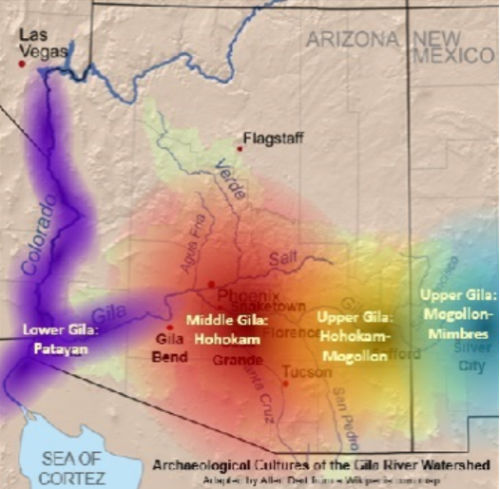 The Antiquity of Irrigation in the Southwest: Before 1500 CE, Native American cultures took advantage of southern Arizona’s long growing season and tackled its challenge of limited precipitation by developing the earliest and most extensive irrigation works in all of North America. Agriculture was introduced to Arizona more than 4,000 years before pre-sent, and irrigation systems were developed there at least 3,500 years ago – several hundred years before irrigation was established in ancient Mexico. This presentation by archaeologist Allen Dart provides an overview of ancient irrigation systems in the southern Southwest and discusses irrigation’s implications for understanding social complexity.
 Archaeological Investigations in Marana’s Crossroads at Silverbell District Park: In this presentation Mr. Dart illustrates artifacts, architecture, and other material culture of southern Arizona’s ancient Hohokam culture, and discusses the archaeological excavations that Old Pueblo Archaeology Center and Desert Archaeology, Inc., conducted at the precontact Yuma Wash Hohokam village archaeological site and the historic Bojórquez-Aguirre Ranch site, which are in the Town of Marana’s Crossroads at Silverbell District Park near the Wheeler Taft Abbett Sr. Library. (This is a 2-hour presentation.)
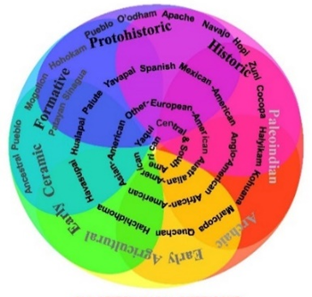
Archaeology and Cultures of Arizona: Many different peoples have contributed to making Arizona such a unique and fascinating cultural place. In this program Mr. Dart summarizes and interprets the archaeologyof Arizona, from the earliest Paleoindians through Archaic period hunters and foragers, the transition to true village life, and the later precontact archaeological cultures (Ancestral Pueblo, Mogollon, Hohokam, Patayan, Sinagua, and Salado). He also discusses connections between archaeology and history, and provides an overview of the Native American, European, Mexican, African, and Asian peoples who have contributed to the Southwest’s recent history. (This is a 3-hour presentation, recommended for two 1½-hour sessions.)
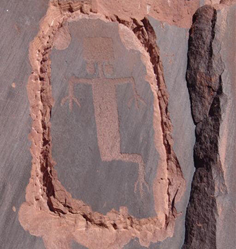
Archaeology and You: Preserving the Past for the Future: Tombs in an ancient Maya city are sacked by looters seeking artifacts to sell. Relic collectors lease an archaeological site and dig it up to collect artifacts, leaving craters littered with human bones and broken grave objects. A petroglyph is chiseled out of a rock face. These actions destroy part of the archaeological record of humankind. In this presentation Mr. Dart notes that artifacts and cultural features ranging from small pieces of pottery and arrowheads to petroglyphs, glass bottles, coins, and other historical objects often are the only sources of information that archaeologists have to answer questions about an ancient people’s way of life, which makes it important for these items to be left undisturbed in their original context.
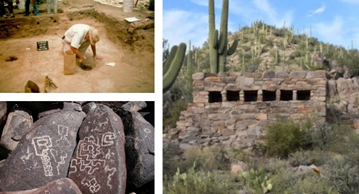
Archaeology in Sabino Canyon, Saguaro National Park and Ironwood Forest National Monument: This presentation provides a brief overview of the archaeology of Arizona, then focuses on illustration and discussion of some of the many archaeological resources in four of southern Arizona’s natural history preserves: Sabino Canyon in the Coronado National Forest, Saguaro National Park’s Rincon Mountains and Tucson Mountains units, and Ironwood Forest National Monument.
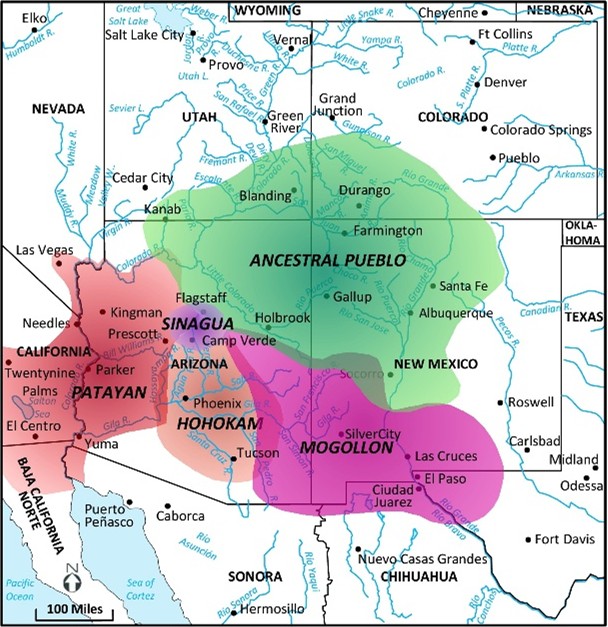
Archaeology of the Southwest – A Brief Overview: This presentation summarizes what archaeologists currently know about the peoples of the U.S. Southwest during the “precontact” times before non-Indian people and their descendants arrived and wrote about them. The first outsider contact with Indigenous peoples was in 1539 during the Spanish colonial expedition of Fray Marcos de Niza and Mustafa Azemmouri (Esteban the Moor) near the Arizona-New Mexico boundary, but for most parts of the Southwest we have no written records until 150 or more years later. Therefore, we rely on archaeology to identify and interpret the peoples and their distinctive cultures that developed before these intrusions. Archaeologists have divided precontact time in the Southwest into sequential stages called the Paleoindian, Archaic, Early Agricultural, Early Ceramic, and Formative cultural periods. It wasn’t until the Formative period of 200 CE and later that the most well-known archaeological cultures arose – the Ancestral Pueblo, Mogollon, Hohokam, Patayan, Sinagua, and Salado. (This is a minimum 1½-hour presentation.)
Archaeology’s Deep Time Perspective on Environment and Social Sustainability: The deep time perspective that archaeology provides on natural hazards, environmental change, and human adaptation not only is a valuable supplement to historical records, it sometimes contradicts historical data that mod-ern societies use to make decisions affecting social sustainability and human safety. What can be learned from archaeological evidence that virtually all pre-contact farming cultures in the Southwest eventually reached a threshold of unsustainability, which probably was a factor in the ultimate collapse or reor-ganization of their societies? Could the 2011 Japanese tsunami’s disastrous effects on nuclear power plants have been avoided if the engineers who decided where to build those plants had not ignored prehistoric archaeological evidence of tsunamis? This presentation looks at archaeological evidence for how human cultures adapt to environmental change.
Artifacts of the Southwest’s Mogollon Archaeological Culture: The Mogollon Native American culture flourished in southeastern Arizona, southwestern New Mexico, western Texas, and northern areas of Chihuahua and Sonora, Mexico, from about the third through fifteenth centuries. Mogollon artifacts provide archaeologists with clues for interpreting how the people of this culture adapted to varied southwestern environments for centuries. In this presentation archaeologist Allen Dart illustrates the material culture of the Mogollon and discusses what it can tell us about this culture’s relationships to the natural world, their time reckoning, religious practices, beliefs, and deities. The presentation includes abundant illustrations of Mogollon pottery and other kinds of artifacts. (This is a 4½-hour program recommended for three 1½-hour sessions.)
Arts and Culture of Ancient Southern Arizona Hohokam Indians: The Hohokam Native American culture flourished in southern Arizona from the sixth through fifteenth centuries. Hohokam artifacts, architecture, and other material culture provide archaeologists with clues for identifying where the Hohokam lived, for interpreting how they adapted to the Sonoran Desert for centuries, and explaining why the Hohokam culture mysteriously collapsed. In this presentation Mr. Dart illustrates artifacts, rock art, and other cultural features of the Hohokam and presents possible interpretations about this culture’s relationships to the natural world, their time reckoning, religious practices, beliefs, and deities, and possible reafor the eventual demise of their way of life. The program features illustrations of archaeological artifacts and features that archaeologists use to define the Hohokam culture.
The First Southwesterners: The Paleoindian and Archaic Peoples: Native Americans legitimately claim their peoples have inhabited the Americas from time immemorial. Archaeology confirms their ancestors’ presence in the Southwest back into the late Pleistocene epoch. In this presentation, archaeologist Allen Dart discusses and illustrates archaeological evidence of the earliest peoples in the American Southwest, from at least 11,000 and possibly as early as 21,000 BCE, up to the time agriculture was introduced to the region around 2100 BCE. (This is a 3-hour presentation, recommended for two 1½-hour sessions.)
Hohokam and Mimbres Rock Art and Ideology: Comparison of 1000-1130 CE Mimbres-culture petroglyphs in New Mexico and contemporaneous ones of the Hohokam culture of southern Arizona helps define the limits of these two ancient southwestern cultures. Aspects of their rock art and other ma-terial culture also provide clues to their different ideologies. Certain icons are common to both Mimbres and Hohokam rock art, whereas each culture also exhibits repeated motifs that apparently were not produced by the other. Comparing and contrasting the shared and unshared rock art images, and other aspects of Mimbres and Hohokam cultures, suggests similarities as well as differences in their respective religious practices and beliefs.
Hohokam Imagery and Timekeeping in Stone: South-central Arizona’s pre-1450 CE Hohokam archaeological culture is known for its distinctive pottery, seashell jewelry, carved stone artifacts, ballcourts, pyramids, and irrigation works. Less well known is Hohokam rock imagery. The “Gila style” petroglyphs richly depict animals, people (or deities?), and geometric designs. “Hohokam Scratched” petroglyphs are rare, subtle, and enigmatic. Hohokam pictographs (rock paintings) also are rare. All three image types appear to have been created in particular ways, suggesting there were social rules for who could make them, and how. And some petroglyphs provide evidence of Hohokam astronomical and calendrical observations. In this presentation archaeologist Allen Dart shows and discusses Hohokam stone imagery and timekeeping.
The Hohokam Southern Frontier Revisited: Excavations at the Continental Site in Green Valley: Between 650 and 1450 CE an agricultural people who archaeologists call the Hohokam were living in southern Arizona, constructing earth-covered wood-and-brush houses built in shallow pits, and producing distinctive pottery and other crafts from stone, bone, and seashells. It has been suggested the Hohokam culture extended southward up the Santa Cruz River valley well beyond Green Valley, Arizona. Recent research at the Continental archaeological site and other places in the Santa Cruz Valley suggests, however, that after 950 CE the Green Valley-southward area was the territory of another ancient culture contemporary with, but different from the Hohokam. (This is a 2-hour presentation.)
Modern and Historical O’odham Culture: Arizona’s “Four Southern Tribes” share close relationships with one another and trace their ancestry to people who inhabited south-central Arizona and part of northern Mexico through geographical, archaeological, linguistic, oral tradition, and historical evidence. These modern tribes refer to themselves as “O’odham” (‘People’) in their native language and historically have been called the Papago and Pima Indians. They occupy several southern Ari-zona Indian reservations but many of their members live and work in communities beyond the reservation boundaries, in Arizona and elsewhere. This presentation provides a brief introduction to the historical and modern O’odham cultures, their roots in the ancient Paleoindian, Archaic, and Hohokam cultures identified by archaeologists, and their prominent place in the modern world.
Old-Time Religion? The Salado Phenomenon in the US Southwest: In the early 20th century, archaeologists in the southwestern US viewed a constellation of distinctive cultural traits – multicolored pottery, houses arranged in walled compounds, and monumental architecture – as evidence of a cultural group they termed “Salado.” Subsequent discoveries cause us to question what the Salado traits really represent. In this presentation archaeologist Allen Dart illustrates some of the so-called Salado culture attributes, reviews theories about Salado origins, and discusses how Salado relates to the Ancestral Pueblo, Mogollon, Hohokam, and Casas Grandes cultures of the US Southwest and Mexico’s Northwest.
Set in Stone but Not in Meaning: Southwestern Indian Rock Art: Ancient American Indian petroglyphs (symbols carved or pecked on rocks) and pictographs (rock paintings) are claimed by some to be forms of writing for which meanings are known. But are such claims supported by archaeology or by Native Americans? Archaeologist Allen Dart illustrates how petroglyph and pictograph styles changed through time and over different parts of the US Southwest both before and after non-Indian peoples entered the region, and discusses how even the same rock art symbol may be interpreted differently from popular, scientific, and modern Native American perspectives. (This is a 2-hour presentation.)
Southwestern Indian Rock Art and Time Reckoning: This multisession presentation includes an overview of ancient southwestern Indian petroglyphs and pictographs, then focuses on how those images and their placement, and certain precontact architectural features, provide evidence of astronomical alignments and possible calendrical reckoning attributes at such places as the Hovenweep area of Utah, the Mesa Verde and Chimney Rock regions of Colorado, New Mexico’s Chaco Canyon archaeological district, and sites in Arizona including Ancestral Pueblo ruins in the northeastern part of the state and the Casa Grande Ruins and Picture Rocks Hohokam sites farther south. (This is a 6-hour presentation designed for three or four separate sessions.)
Tangible History: Some Southern Arizona Archaeological and Historic Sites: Archaeological and historic sites provide tangible evidence of a region’s past and of how cultures have changed over time. There are thousands of such sites in southern Arizona that most people know nothing about. In this presentation, Mr. Dart provides an overview of southern Arizona archaeology and cultures and shares information about some of these sites, including ones open for public visitation.
Allen Dart accepts suggestions for speaking about other archaeology-related topics.
For more information or to schedule a presentation contact Mr. Dart at
Old Pueblo Archaeology Center PO Box 40577
Tucson AZ 85717-0577 USA
520-798-1201 or adart@oldpueblo.org
Illustration credits:
Ancient Native American Pottery of Southern Arizona: William L. Deaver
Ancient Southwestern Native American Pottery: Mimbres Pottery Database (MimPIDD)
Archaeological Investigations in Marana’s Crossroads at Silverbell District Park pottery bowl:
Desert Archaeology, Inc. and Old Pueblo Archaeology Center
Archaeology and Cultures of Arizona: Allen Dart
Archaeology and You: Preserving the Past for the Future: US Bureau of Land Management
Archaeology in Sabino Canyon, Saguaro National Park and Ironwood Forest National Monument:
Excavation, Old Pueblo Archaeology Center; petroglyphs, Allen Dart; CCC building, The Living New Deal, https://livingnewdeal.org/
Archaeology of the Southwest – A Brief Overview: Allen Dart
Archaeology’s Deep Time Perspective on Environment and Social Sustainability:
“Zuni Planting Scene, 1882,” Willard Leroy Metcalf, gouache on paper, New Mexico Museum of Art (Museum acquisition, 1965; 1880.23D);
“Plowing with Moldboard Plow on Northern Great Plains 1880-1920,” Library of Congress
Artifacts of the Southwest’s Mogollon Archaeological Culture:
Office of Archaeological Studies, New Mexico Museum of Indian Arts and Culture
Arts and Culture of Ancient Southern Arizona Hohokam Indians: Arizona State Museum, University of Arizona, Helga Teiwes, photographer
The First Southwesterners: The Paleoindian and Archaic Peoples:
Projectile points, Gwen Buttrill and Archaeology Southwest; Grand Canyon split-twig figurine in Arizona State Museum gallery, Allen Dart
Hohokam and Mimbres Rock Art and Ideology: base map www.arizona-map.org and www.new-mexico-map.org
Hohokam Images and Timekeeping in Stone: Tom Herrick
The Hohokam Southern Frontier Revisited: Excavations at the Continental Site in Green Valley:
Base map www.arizona-map.org; added labels, Allen Dart
Modern and Historical O’odham Culture:
Gila River Indian Community, Tohono O’odham Nation, Salt River Pima-Maricopa Indian Community, Ak-chin Indian Community Old-Time Religion? The Salado Phenomenon in the US Southwest: El Paso Museum of Archaeology, Jeff Romney, photographer Set in Stone but Not in Meaning: Southwestern Indian Rock Art: Picture Rocks Redemptorist Renewal Center
Southwestern Indian Rock Art and Time Reckoning: National Park Service Facebook page https://www.facebook.com/nps.chcu/posts/sun-watchingthe-great-icon-here-at-chaco-culture-national-historical-park-for-su/4314175851958445/
Southwestern Rock Calendars and Ancient Time Pieces: Allen Dart
Tangible History: Some Southern Arizona Archaeological and Historic Sites:
Projectile points, Department of Anthropology, University of Arizona; pithouse and petroglyphs, Allen Dart; San Xavier Mission, Wikimedia Commons